

An unpopular opinion (from practice): Microsoft isn't perfect. But if you soberly look at strategy, platform breadth, and ecosystem, its current market position isn't a "coincidence" but a result. And those who talk about alternatives must distinguish between "replacing a component" and "replacing a platform."
1) First off: This isn't a fanboy text – it's a reality check
I know the pain points. Admin Center UI/UX, menus moving, things suddenly being called differently. Sometimes it feels like "redesigning icons" is more important than "easing the admin's daily life." Nevertheless, my point remains: Microsoft delivers a suite that is hard to beat in terms of breadth and integration.
The apt comparison? FC Bayern. Not everyone's favorite – but smart financial and squad policy leads to quality on the field. Microsoft operates similarly: not flawless, but effective. No company does "everything" right. Yet, economically, Microsoft is a heavyweight – and many others would have missed opportunities or only keep up with external help. The leadership position is earned, hard-won, and strategically secured.
The numbers speak for themselves:
- 3.7 million companies worldwide use M365
- 345 million paid subscribers (Business + Consumer)
- Over 80% of German SMEs rely on Microsoft Office packages
- 70% of Fortune 500 companies use M365
- From 1 to 300,000+ employees: M365 scales for everyone
Microsoft 365 is not just "Word & Excel." It's a universe of Teams, SharePoint, OneDrive, Exchange, and Intune.
2) The underestimated lever: Platform breadth
A core argument I constantly have to make in discussions: Endpoint and device management is no longer just Windows. Microsoft explicitly documents support for Android, iOS/iPadOS, macOS, and Windows (and additionally Linux/ChromeOS) for Intune.

This is relevant because it means: A single control point for many device classes in a central model. When a solution is so widespread in the market, an ecosystem of integrations, know-how, and tooling automatically emerges, which collectively generates more value than the pure feature list.
3) The M365 ecosystem: The real cheat code
Over the last ten years, Microsoft 365 has matured into the reference platform, and the development speed of the last two or three years is simply insane. For admins, this means staying vigilant daily.
What makes the difference is the unique community – breadth, depth, pace.
From my practice:
- For almost every problem, there are already documented workarounds or ready-made solutions.
- Around Intune, Entra ID, and Defender, tools are constantly emerging from the community. One example is the over 13 free Intune tools by Ugur Koc (ugurlabs.com).
- The third-party ecosystem is enormous: from Infrastructure-as-Code (M365 DSC) to specialized security integrations.
This "suite logic" not only provides convenience – it actually reduces complexity in many organizations because identities, devices, apps, and data flows can be thought of in a coherent model. The default operating model is manageable for many companies – from very small to very large – because it doesn't necessarily require 12 products before the workplace is stable and secure.
4) Alternatives: Yes – but please classify them honestly
I say it more clearly today than before: There are alternatives – but a single-vendor replacement for the entire suite (Productivity + Collaboration + Identity + Endpoint + Compliance) is rare in practice. Mostly, you replace components, not the entire platform.

| Area | Microsoft 365 | Alternatives (Components) |
|---|---|---|
| Office & Collaboration | Office Apps, Teams | Google Workspace, Nextcloud |
| Identity (IAM) | Entra ID | Okta, Ping Identity, JumpCloud |
| Endpoint (MDM/UEM) | Intune | Jamf (Apple), Workspace ONE, Ivanti |
| Security | Microsoft Defender XDR | CrowdStrike, SentinelOne |
| Compliance | Purview | Specialized GRC Tools |
No one delivers the integrated solution like Microsoft. Open-source stacks work, but are often a patchwork: integration, operation, security, upgrades – that consumes resources. What M365 provides "out of the box" has to be laboriously rebuilt there.
5) Data Sovereignty & Backup: Pragmatic Risk Minimization
The debate about data sovereignty is often heated and emotional in Germany and Switzerland. My point: If you want to use the cloud meaningfully, you need basic trust in certificates, compliance proofs, and regulation. GDPR compliant with Microsoft? Yes, it's possible — but be precise about who owes what. Microsoft supplies the contractual and technical building blocks (the Data Protection Addendum, the evidence in the Service Trust Portal, Purview Compliance Manager). Compliance itself stays a shared responsibility: you still have to document it for your own processing.
The Cloud Act affects all US corporations, not just Microsoft. In Switzerland, data protection officers (Privatim) passed a resolution in November 2025 recommending that authorities use cloud services in a differentiated manner. Nevertheless, many cantons continue to use M365 extensively.
Backup doesn't solve sovereignty – but it significantly reduces risk
Backup doesn't automatically answer questions about jurisdiction, but it creates agency. If a provider fails, if data is encrypted/deleted, or if you need to switch for strategic reasons – then you need restore capability.
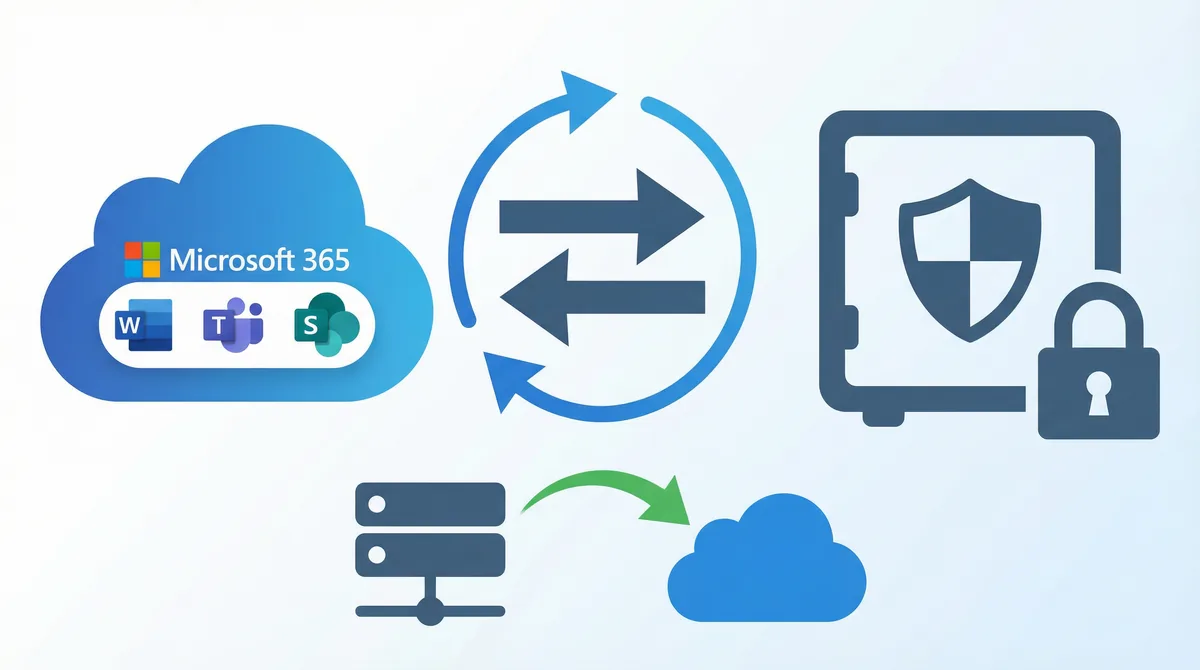
My pragmatic lever: Independent backups for SharePoint, OneDrive, Exchange, and Teams (e.g., Veeam, Commvault, AvePoint). Microsoft has had its own first-party product since 2024, Microsoft 365 Backup for SharePoint, OneDrive and Exchange Online, billed pay-as-you-go. It is worth knowing what it is and what it isn't: Microsoft states plainly that the data never leaves the Microsoft 365 data trust boundary. That makes it a fast recovery tool — and precisely not an exit enabler. Which is exactly why an independent, off-platform copy still matters.
- Independent recovery: Locally or to an alternative cloud.
- Exit enabler: Should Microsoft no longer be available overnight, your data is secured.
- Control: You retain sovereignty over your data – regardless of the provider.
6) Conclusion: Less ideology, more operational capability
I'm not a fanboy. I'm a pragmatist. You don't have to love Microsoft – but its dominance is rationally explainable: suite breadth, platform support across multiple OS, and an ecosystem that is hard to copy.
Alternatives exist – often very good ones – but mostly as components. And backup isn't the solution to all sovereignty questions, but a strong risk reducer and a realistic exit enabler.
Zero Trust. Zero Drama. Zero Bullshit.
What's your opinion? Do you use M365 – or have you found alternatives that really work? Write it in the comments!
Philipp Schmidt
M365 Solution Architect
👉 More Info: easym365.de | endlesstech.blog
References
- DataStudios (2025): M365 Usage Statistics.
- SignHouse (2024): Microsoft 365 Paid Subscribers.
- Intra2net (Sept. 2024): IT Usage in German SMEs.
- Expert Insights: M365 Adoption in Fortune 500.
- Microsoft Learn: Intune Platform Support
- Steiger Legal (Nov. 2025): Privatim Resolution on Cloud Usage.